

ISO 9001: What Is a Quality Management System and Why Do Organizations Need It?
- Learn about ISO 9001 as a Quality Management System, and how URS Jordan helps organizations start the ISO 9001 Certification pathway within a clear scope and professional audit methodology.
- ISO 9001 is one of the well-known international standards in the field of Quality Management Systems. It provides a clear framework that helps organizations structure their processes, improve performance consistency, strengthen quality control, and enhance their ability to meet customer and stakeholder requirements.
- The importance of ISO 9001 is not limited to quality alone; it also serves as a management methodology that helps organizations move from individually driven practices to a clearer, more disciplined, measurable, and continually improvable system.
- In this context, URS Jordan provides Management Systems Certification services, including ISO 9001, as a professional pathway that begins with understanding the organization’s scope and processes, then reviewing the application and defining process requirements, leading to audit and decision-making based on the program, scope, and evidence, without any prior promise of outcome or certification.
What Is ISO 9001?
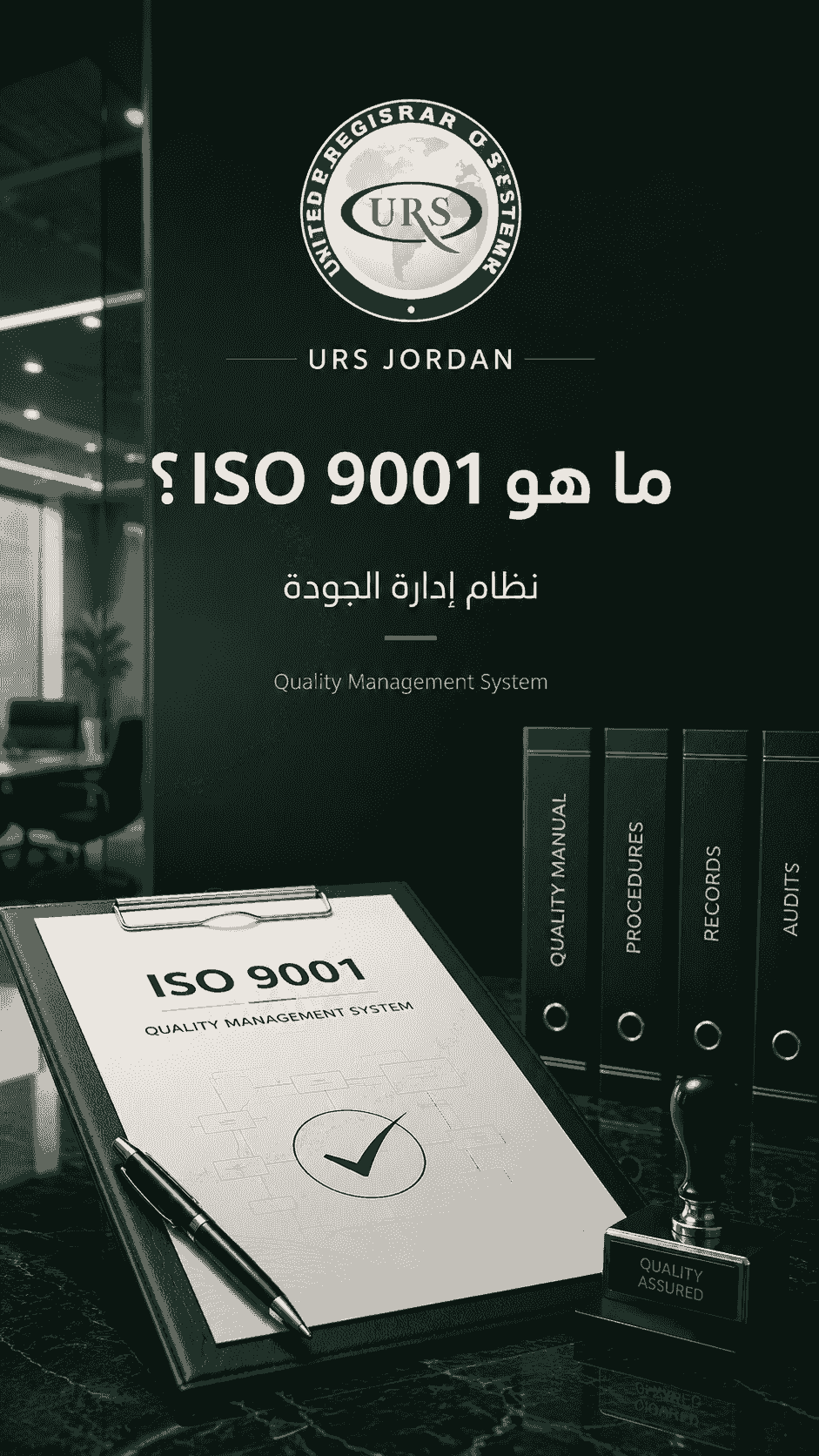
ISO 9001 is an international standard that defines the requirements for establishing a Quality Management System (QMS) within an organization. The purpose of this system is to organize the way work is performed, clarify responsibilities, control processes, and improve the organization’s ability to consistently deliver products or services that meet agreed requirements.
In simpler terms, ISO 9001 does not view quality only as a final result; rather, it treats quality as an integral part of how an organization manages its daily operations—from planning, to implementation, to evaluation, and ultimately to continual improvement.

How Does ISO 9001 Help an Organization?
The ISO 9001 Quality Management System helps an organization connect its objectives with its processes, responsibilities, resources, and performance measurement methods. This alignment creates greater operational clarity, reduces reliance on individual practices, and improves the organization’s ability to identify where issues occur and address them through a structured approach.
Through implementing ISO 9001, an organization can improve documentation, clarify roles and responsibilities, reduce variation in how activities are performed, strengthen internal monitoring, and enhance its ability to make decisions based on data and performance indicators rather than assumptions or temporary corrective actions.
When Does an Organization Need ISO 9001?
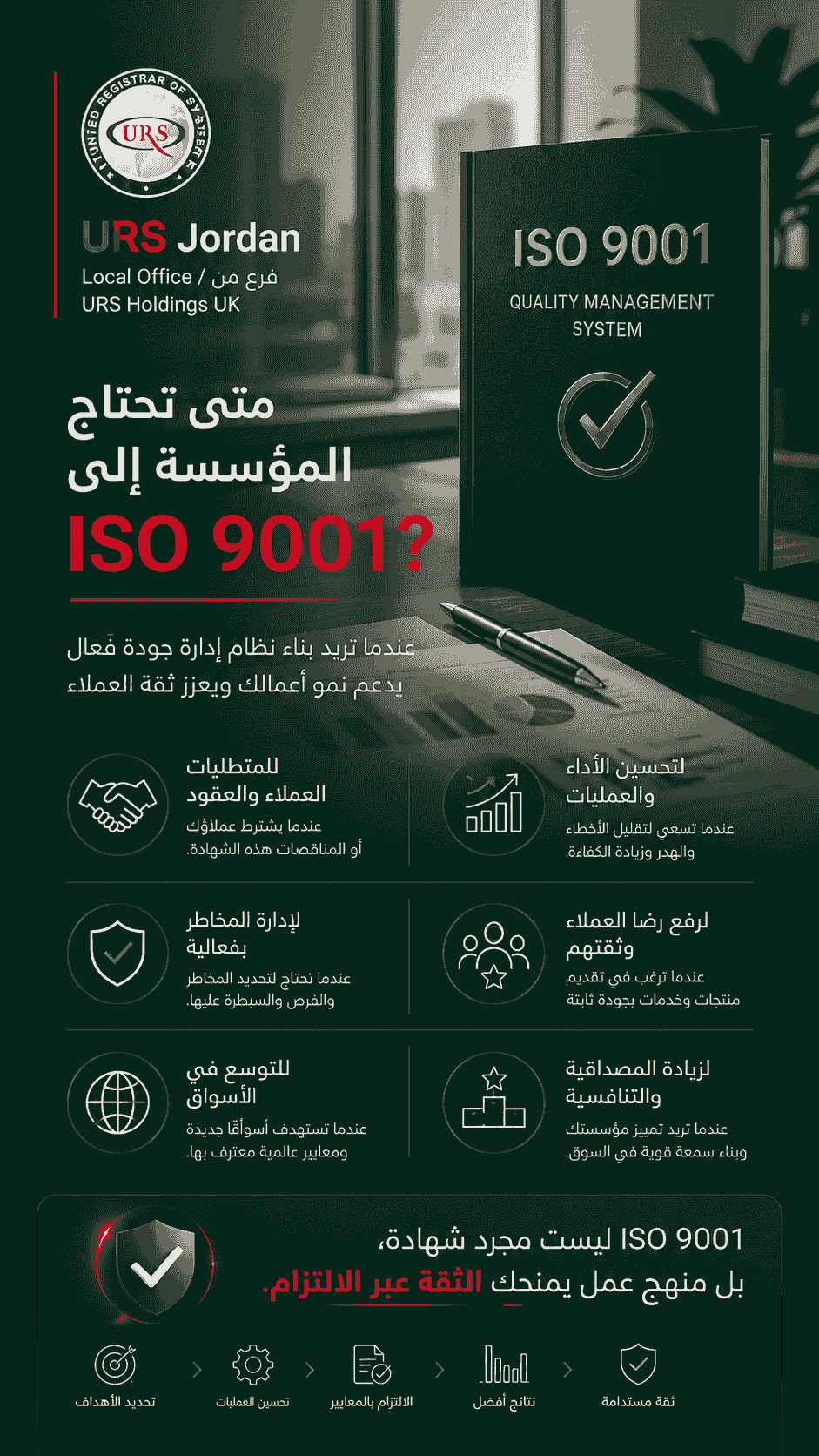
Organizations typically need ISO 9001 when they aim to improve quality performance, organize operational processes, increase customer satisfaction, standardize practices across departments, or reduce errors and inconsistencies in the way products or services are delivered.
ISO 9001 also becomes increasingly important when an organization deals with contractual requirements, supply chains, or customers that demand a higher level of structure and reliability, or when there is a need to demonstrate the existence of a clear and implemented Quality Management System within a defined scope.
The standard may also be particularly relevant during periods of expansion, business restructuring, entry into new markets, or when improving the organization’s image and credibility with customers, partners, and other interested parties.

Key Foundations of the ISO 9001 Quality Management System
ISO 9001 is built upon a set of important management foundations, including understanding the organization’s context, identifying the needs of interested parties, defining the scope of the Quality Management System, clarifying responsibilities and authorities, managing risks and opportunities, controlling processes, measuring performance, and driving continual improvement.
These elements should not be understood as isolated theoretical requirements, but rather as interconnected components that help organizations improve the way work is managed and connect quality with planning, implementation, evaluation, and ongoing development.

Benefits of Implementing ISO 9001 Within an Organization
One of the key practical benefits of implementing ISO 9001 is that it helps an organization improve process quality, increase consistency across departments, strengthen documentation, clarify responsibilities, and improve how nonconformities, complaints, and feedback are handled.
It also supports the development of a more aware management culture focused on objectives and requirements, and helps the organization monitor performance through indicators or auditable evidence, rather than treating quality as a separate topic from daily operations.
When the Quality Management System is connected to the organization’s operational reality, it becomes more capable of supporting performance, improvement, and continuity, rather than remaining a set of documents or forms that do not reflect the actual way work is performed.

Is ISO 9001 Suitable for All Organizations?
ISO 9001 serves a wide range of organizations, whether industrial, service-based, educational, healthcare, commercial, or technology-related. The standard is not limited to a specific sector or organization size; it can be applied by small, medium, and large organizations depending on the nature of their activities, operational scale, and level of complexity.
The flexibility of ISO 9001 lies in the fact that it does not impose a single management model. Instead, it establishes requirements that help an organization build a Quality Management System suited to its own context, operational nature, and specific needs.

ISO 9001 Is Not Just Documentation
One of the common misconceptions about ISO 9001 is viewing it as merely a set of documents or forms that need to be prepared. Actual implementation of the standard requires the system to be connected to the organization’s real way of working and to reflect its processes, responsibilities, and requirements as they are genuinely practiced.
The closer the Quality Management System is to operational reality, the more effective it becomes, the better it can support performance and improvement, and the more sustainable and adaptable it will be over time.
On the other hand, a formal system disconnected from daily operations may create an administrative burden without delivering the intended benefits of the standard.

The Difference Between Implementing ISO 9001 and Obtaining ISO 9001 Certification
It is important to distinguish between implementing ISO 9001 within an organization and obtaining ISO 9001 Certification.
Implementing ISO 9001 means establishing a Quality Management System within the organization, organizing processes, clarifying responsibilities, controlling documentation, monitoring performance, and working toward continual improvement.
Obtaining ISO 9001 Certification, on the other hand, is related to an assessment and audit pathway conducted by a third-party body, within a clear scope, defined requirements, audit methodology, and reviewable evidence. Certification should not be treated as a pre-guaranteed outcome, but as a decision subject to program requirements, scope, and evidence.
Therefore, an organization that views ISO 9001 merely as a certificate may lose a significant part of its actual value, while an organization that understands it as a practical management system can benefit from it internally by improving performance, and externally by supporting trust with customers and relevant stakeholders.

How Can URS Jordan Support the ISO 9001 Certification Pathway?
URS Jordan operates as a Local Office within the URS Holdings UK framework and provides Management Systems Certification services, including ISO 9001, within a third-party structure based on scope clarity, audit methodology, traceability of outputs, and compliance with the requirements of the relevant program.
Practical support begins with reviewing the organization’s initial information, such as activity scope, locations, processes, outsourced processes, and any specific requirements related to the market or customer expectations. Based on this information, the application can be reviewed and a structured quotation prepared that clearly defines the service scope and pathway requirements.
URS Jordan does not provide ISO 9001 Certification as a guaranteed outcome; rather, it provides a professional certification pathway based on auditing, assessment, and decision-making according to applicable requirements, evidence, and the defined scope.

What Makes ISO 9001 Implementation Successful?
The success of ISO 9001 does not depend only on preparing documentation or getting ready for an audit. It depends on having a clear purpose for the system, management commitment, understanding of processes, involvement of relevant teams, and defining the scope of implementation realistically.
Success also depends on an organization’s ability to use the Quality Management System as a tool for improving performance rather than as an additional administrative burden. For this reason, effective implementation begins with fundamental questions: Why do we need this system? What issues are we trying to address? How will we connect the requirements to the work environment? And how will improvement be measured?

Conclusion
ISO 9001 is not merely a quality standard in the traditional sense; it is a practical framework that helps an organization build a clearer, more consistent, and continually improvable Quality Management System.
Its real value begins when it is used to organize work, improve processes, clarify responsibilities, and enhance the organization’s ability to monitor and develop performance. ISO 9001 Certification, on the other hand, comes through a professional pathway based on a clear scope, audit methodology, and assessable evidence, without assuming a predetermined outcome.
Through URS Jordan, organizations wishing to start the ISO 9001 Certification pathway can request an initial scope review and obtain a structured quotation, helping them understand process requirements before entering the audit and decision stages.


