

ISO 45001 Certification in Jordan | Occupational Health & Safety Management System | URS Jordan
The international standard ISO 45001 is considered a key framework for organizations and companies in Jordan seeking to build a safe and sustainable working environment. This global system aims to enable organizations to manage operational risks effectively and reduce workplace incidents and occupational injuries, helping provide protection for personnel, visitors, and all parties operating within the work environment.
The Management Importance of ISO 45001:2018
The Occupational Health and Safety Management System (ISO 45001) is not limited to being a preventive tool for protecting individuals; it also represents an integrated strategic framework that links safety with the organization’s management system through:
- Planning and governance of responsibilities: Integrating safety requirements into daily operational processes.
- Compliance with local regulations: Aligning the system with Jordanian labor law and Ministry of Labour instructions related to occupational safety.
- Evaluation and continual improvement: Adopting periodic audit methodologies to identify performance gaps and strengthen an organizational safety culture.
ISO 45001 Certification Pathway with URS Jordan
URS Jordan provides Management Systems Certification services and ISO 45001 Certification within the Jordanian market through an independent and rigorous audit methodology as a Third-party Certification Body.
Our professional certification pathway begins through clear and defined steps:
- Understanding the organization’s context: Gaining a clear understanding of the organization’s activities, workplace risks, and operational processes.
- Reviewing the certification application: Professionally reviewing the application and identifying scheme requirements and audit timelines.
- On-site audit and decision process: Assessing objective evidence and evaluating conformity with the international standard to support certification decisions or identify additional requirements.
Principle of integrity and impartiality: In line with governance requirements and international accreditation frameworks associated with URS (such as UKAS accreditation), we confirm that our audit pathway is fully based on actual evidence and disciplined implementation within the approved accreditation scope, without providing any prior commitments or guarantees regarding audit success or certification outcomes.

What Is the ISO 45001 Occupational Health and Safety Management System?
ISO 45001 is widely recognized as a leading international standard for establishing an Occupational Health and Safety Management System. The system does not treat safety as an emergency procedure; rather, it integrates safety as an essential part of the organization’s daily operations to identify risks and prevent workplace incidents.
The continual improvement cycle of the system:
Planning: Identifying occupational hazards and developing preventive policies.
Operation: Effectively applying safety controls in daily activities.
Evaluation: Conducting periodic monitoring, performance review, and incident investigation.
Improvement: Taking corrective actions to ensure continual improvement of the work environment.

Why Does an Organization Need ISO 45001?
Organizations may need to implement the ISO 45001 Occupational Health and Safety Management System in the following situations:
Proactive risk management: To move from a reactive approach after incidents occur to a preventive and structured approach focused on anticipating and controlling risks.
Work environments with operational risks: Such as construction and contracting sectors, manufacturing facilities, logistics services, healthcare, laboratories, and maintenance operations.
Protection of the overall work environment: To control and ensure the safety of everyone within the organization, including employees, contractors, and visitors.
Tender and market requirements compliance: To demonstrate the existence of an internationally recognized Occupational Health and Safety Management System, which may support participation in major tenders and strengthen customer confidence.

How Does ISO 45001 Help Improve the Work Environment?
ISO 45001 helps organizations improve the work environment through strategic steps designed to support structured occupational health and safety practices:
Risk management: Identifying hazards, assessing risks, and implementing preventive controls to reduce workplace incidents and occupational illnesses.
Responsibility governance: Defining roles and responsibilities across management and operational teams while linking occupational health and safety with training and organizational objectives.
Daily workplace culture: Integrating occupational health and safety requirements into actual operations so that the system becomes more than documents and instructions, evolving into a sustainable daily practice that helps protect employees, contractors, and visitors.
Key Foundations of ISO 45001
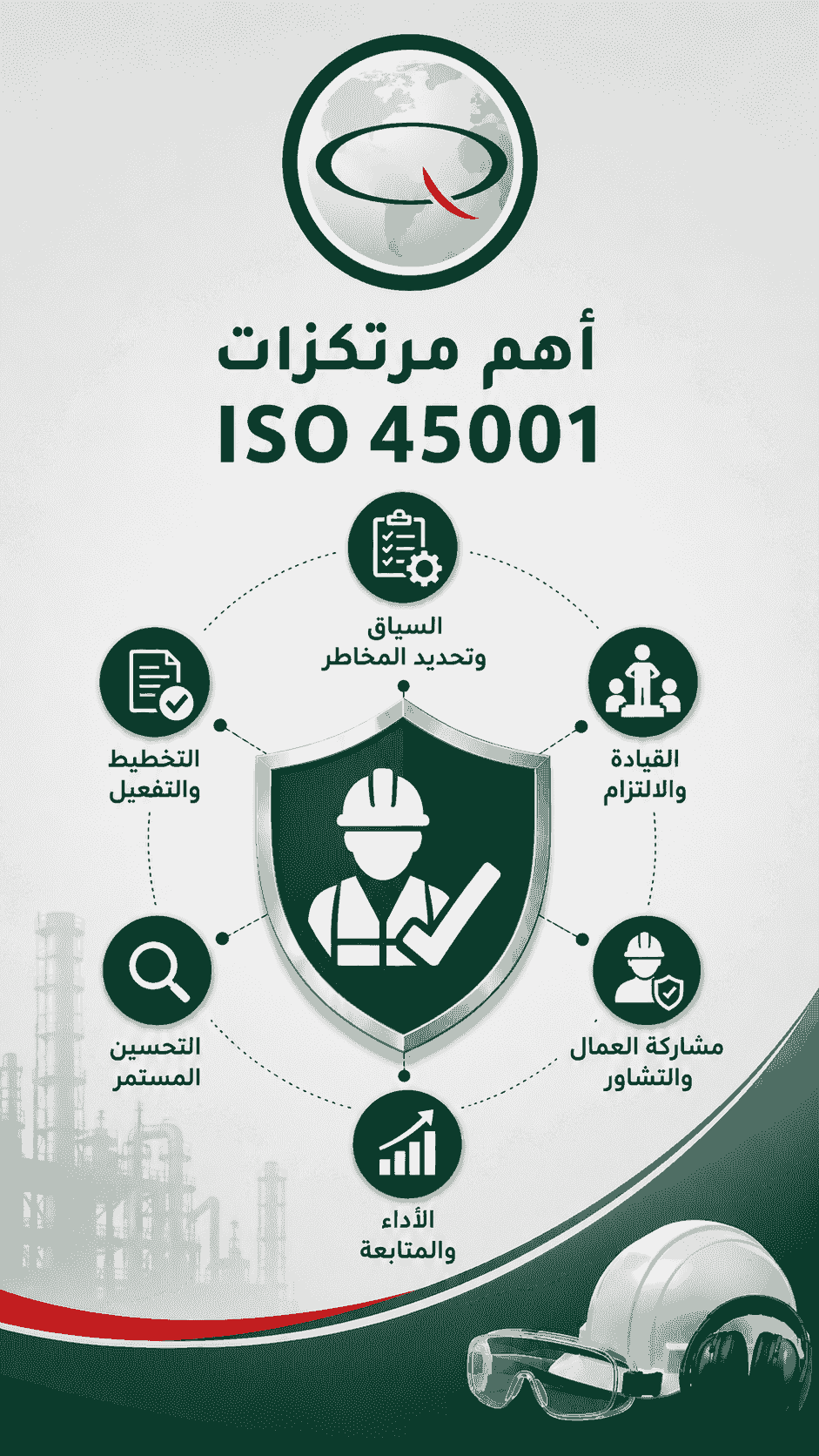
The ISO 45001 system is built on management and operational foundations that support the creation of a safe work environment aligned with international standards:
Operational system foundations: These include understanding the organization’s context, defining the scope and interested parties, assessing risks and opportunities, complying with legal and regulatory requirements, controlling operational processes, and preparing for emergency situations.
Continual improvement and worker participation: The standard emphasizes performance measurement and the importance of worker consultation and participation. The success of occupational health and safety depends not only on management decisions, but also on the awareness and involvement of individuals who face daily workplace risks.

Benefits of Implementing ISO 45001 Within an Organization
ISO 45001 provides organizations with a competitive advantage by strengthening occupational health and safety management through:
Operational excellence: Reducing risks, clarifying responsibilities, increasing employee awareness, and managing incidents and nonconformities through a structured approach based on root cause analysis and corrective actions.
Strategic value: Building a structured work environment that strengthens customer confidence and supports organizational readiness for tenders, major projects, and contractual requirements that may require an internationally recognized occupational health and safety management system.

Is ISO 45001 Suitable for All Organizations?
Flexibility of ISO 45001 Implementation Across Different Sectors
ISO 45001 is designed with a high degree of flexibility, allowing it to be implemented across a wide range of organizations to manage occupational health and safety risks:
Sector applicability: It can be applied within industrial, construction, service, logistics, healthcare, and educational organizations regardless of their size.
Practical implementation and scope: The implementation approach varies according to the nature of activities. Risks within construction sites and manufacturing facilities differ significantly from those in administrative office environments. Therefore, URS Jordan supports the development of a realistic system scope aligned with actual operations and geographical locations to support conformity with applicable requirements and international practices.

ISO 45001 Is Not Merely Safety Procedures
It is inaccurate to reduce ISO 45001 to documents, forms, and paperwork. Effective implementation requires a living system that reflects the operational reality of the organization:
Actual implementation: The system does not stop at having a safety policy; it connects risk assessment with daily monitoring, incident investigation, awareness, and emergency response.
Organizational safety culture: The more the Occupational Health and Safety Management System is based on the organization’s real working environment, the more effectively it can improve discipline and reduce incidents, transforming from paperwork requirements into a sustainable daily work culture that strengthens organizational efficiency.

The Difference Between Implementing ISO 45001 and Obtaining ISO 45001 Certification
Organizations should clearly distinguish between building the system internally and obtaining external certification:
ISO 45001 implementation: Refers to establishing an internal Occupational Health and Safety Management System, identifying risks, implementing controls, and governing responsibilities to improve the work environment.
ISO 45001 Certification: Refers to an independent audit pathway conducted by a third-party certification body to assess objective evidence and conformity. Certification should not be considered a guaranteed outcome, but rather a decision based on compliance with applicable requirements.
Focusing on ISO 45001 as a risk management system can provide long-term value and strengthen customer confidence, rather than viewing it solely as a certification document.

How Can URS Jordan Support the ISO 45001 Certification Pathway?
As a Local Office within URS Holdings UK, we provide independent third-party audit services for ISO certification pathways:
Audit methodology: Our process begins with reviewing the organization’s information, including scope, locations, occupational risks, and legal compliance considerations, to prepare a structured quotation that clearly outlines the service pathway.
Integrity and transparency: URS Jordan does not provide ISO 45001 Certification as a procedural formality or a guaranteed outcome. Instead, we provide a professional certification pathway based on the assessment of objective evidence, clear scope definition, and applicable audit program requirements to support a structured and well-governed system process.

Conclusion
ISO 45001 goes beyond traditional safety instructions. It represents an integrated management framework for identifying occupational risks, governing responsibilities, and increasing worker awareness to support continual improvement of the work environment.
Steps toward certification: ISO Certification is subject to an independent third-party audit pathway based on the assessment of objective evidence and clear scope definition, without prior guarantees.
Start your pathway: URS Jordan enables organizations seeking operational excellence to request an initial scope review and obtain a structured quotation, helping them understand the requirements of the international audit process before the actual assessment begins.